
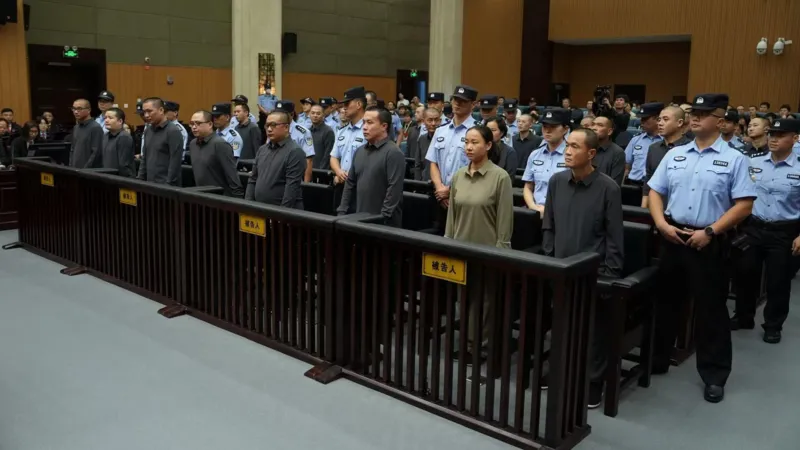
A Chinese court has handed down death sentences to 11 members of the Ming family, a notorious clan accused of running scam operations in Myanmar, according to Chinese state media.
Dozens of the family’s members were convicted of various criminal activities, with many receiving long prison terms.
The Ming family was part of one of four dominant clans controlling the town of Laukkaing in Myanmar, near the Chinese border. The town had become a hub for gambling, drug trafficking, and online scam centres.
In 2023, Myanmar authorities cracked down on these operations, arresting several family members and transferring them to Chinese custody.
On Monday, a total of 39 members of the Ming family were sentenced in Wenzhou, eastern China, according to Chinese broadcaster CCTV. In addition to the 11 death sentences, five received death penalties with two-year reprieves, 11 were sentenced to life imprisonment, and the remainder received jail terms ranging from five to 24 years.
The court concluded that since 2015, the Ming family and other criminal groups had engaged in fraud via telecommunications, illegal casino operations, drug trafficking, and prostitution. Their gambling and scam activities reportedly generated over 10 billion yuan (approximately $1.4 billion or £1 billion). Previous estimates suggested that the clans’ casinos each processed several billion dollars annually.
The court also found that the Ming family and associated criminal networks were responsible for multiple deaths of scam centre workers, including shootings intended to prevent staff from fleeing back to China.
Originally established to exploit Chinese demand for gambling, which is illegal in China and many neighboring countries, Laukkaing’s casinos gradually became a front for money laundering, human trafficking, and online fraud. The town has been described by the UN as a centre of the “scamdemic,” in which over 100,000 foreign nationals—mostly Chinese—were reportedly coerced into working in scam centres under harsh conditions.
At its peak, the Ming family controlled compounds housing as many as 10,000 workers, the most infamous being Crouching Tiger Villa, where abuse and torture were common.
Two years ago, an alliance of insurgent groups launched an offensive that ousted Myanmar’s military from large areas of Shan State, taking control of Laukkaing. China, which wields influence over these groups, is believed to have approved the operation. Following this, family patriarch Ming Xuechang reportedly took his own life, while other family members were handed over to Chinese authorities, some of whom admitted guilt. Thousands of scam centre workers were also transferred to Chinese custody.
These sentences underscore China’s determination to crack down on scam operations along its border. Beijing’s pressure has also prompted Thailand to act against similar operations along its border with Myanmar earlier this year.
Despite these measures, scam networks have adapted, relocating much of their operations to Cambodia, though Myanmar continues to host such criminal activity.
ALSO READ : China Unveils World’s Tallest Bridge in Guizhou
Source – BBC

For comments, Feedback and Opinions do get in touch with our editor on WhatsApp: +44 7949 297606 or Email: editor@thezimbabwetimes.co.zw.

