
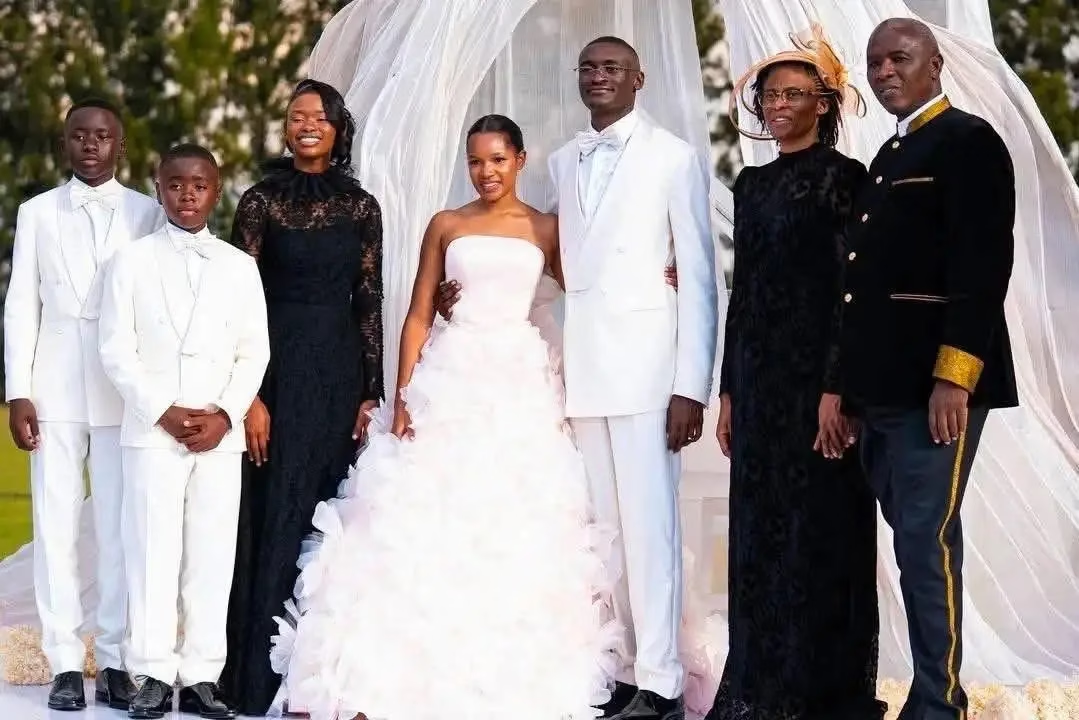
Harare, Zimbabwe | The recent nuptials of Taonanyasha John Tagwirei and Poneso Tinomuda Janda transcended the realm of a mere family celebration, morphing into a potent symbol of Zimbabwe’s stark social and economic disparities. Far from a private affair, this union of scions from prominent families ignited a national discourse, becoming a social media phenomenon and a poignant reflection of contemporary Zimbabwean society.
The lavishness surrounding the event was underscored by widely circulated claims on social media platforms. Businessman Kudakwashe Tagwirei reportedly gifted the couple US$2.5 million and 33 hectares of prime Umwinsidale land, allegedly valued at an astonishing US$15 million. This revelation alone propelled the wedding beyond personal festivity into the arena of public political commentary.
Further intensifying public fascination were reports of other significant contributions: Wicknell Chivayo’s alleged US$250,000 and a luxury designer bag, Scott Sakupwanya’s reported US$500,000, Obey Chimuka and his wife’s US$275,000, George Guvamatanga’s 25 pedigree Beefmaster heifers and US$250,000, and gospel musician Everton Mlalazi’s US$150,000. These figures, while substantial in their own right, gained particular resonance when juxtaposed against the lived realities of most Zimbabweans.
These extravagant displays of wealth unfolded in a nation grappling with profound systemic failures. While women endure the indignity of sleeping on hospital floors at Parirenyatwa, and residents in areas like Glen View and Budiriro face chronic water shortages, the wedding served as a stark reminder of a privileged few seemingly insulated from such hardships. Graduates in Chitungwiza resort to selling airtime by roadsides, informal traders in Mbare flee municipal police, and thousands of young Zimbabweans continue to seek economic refuge in neighbouring countries and beyond, highlighting a desperate search for dignity and survival.
This profound contrast transformed the wedding into a politically charged event. The burgeoning enclaves of Borrowdale Brooke and Umwinsidale, characterised by manicured lawns, private boreholes, imported luxuries, high-end vehicles, and armed security, stand in stark opposition to areas like Epworth, where raw sewage meanders through settlements devoid of proper infrastructure. Zimbabwe’s inequality is not merely economic; it is a spatial segregation mirroring the oligarchic societies of Latin America or the plutocracies of post-Soviet states.
The intense public reaction was not solely a response to wealth itself, but rather to its ostentatious public performance. Throughout history, elites have often staged grand spectacles during periods of societal strain. The American Gilded Age, Mobutu Sese Seko’s Zaire, post-Soviet Russia, and the Zuma era in South Africa all offer precedents of conspicuous consumption amidst widespread hardship. However, Zimbabwe’s situation is rendered uniquely volatile by the fragility of its state institutions.
Unlike nations where elite extravagance might occur against a backdrop of functional state infrastructure, Zimbabwe’s displays of immense wealth are set against collapsing municipal governance, persistent power cuts, critical medicine shortages, and chronic economic instability. This context imbues elite spectacle with a sharper, more dangerous political edge.
The rise of politically connected business elites, while not entirely new, has been significantly amplified and normalised under the current administration. The post-2017 political transition witnessed the emergence of a more confident and publicly visible class of tycoons whose fortunes were often linked to Command Agriculture, fuel contracts, opaque procurement systems, and controversial dealings in the gold sector. Entities like Sakunda Holdings and individuals such as Kudakwashe Tagwirei, Wicknell Chivayo, and Scott Sakupwanya have become integral to Zimbabwe’s political lexicon, not just its business landscape.
In this environment, public gifting, whether intended or not, carries significant political meaning. Announcing a US$500,000 wedding gift in a struggling economy transcends mere generosity; it becomes a form of signalling. It communicates hierarchy, influence, access, and power, transforming acts of gifting into public spectacles that reinforce social stratification.
While traditional African societies historically celebrated generosity through communal feasting and symbolic redistribution of wealth, modern elite spectacle in Zimbabwe increasingly resembles hyper-capitalist branding exercises. Luxury gifting now functions akin to corporate sponsorship or political theatre, further alienating the populace.
The emotional dichotomy observed online following the wedding—a mix of fascination, admiration, vulgarity, aspiration, humour, cynicism, outrage, and envy—underscores this complex dynamic. Social media platforms became a national referendum on wealth, with discussions and memes dissecting every aspect of the event. Zimbabweans at home and abroad debated whether the spectacle represented economic success or moral decay, highlighting how elite ceremonies have become mass participatory political events in a digitally connected nation.
Yet, there exists an uncomfortable truth many Zimbabweans struggle to articulate: a simultaneous resentment and worship of wealth. The same public that decries extravagant spending often obsessively follows the lifestyles of the wealthy online. In an economy where formal upward mobility is increasingly elusive, conspicuous wealth becomes both offensive and aspirational—a contradiction at the heart of the Zimbabwean condition.
The political establishment faces a perilous risk: that such spectacle will inevitably harden into social alienation. History teaches that ruling systems become unstable when elites appear detached from the material realities of ordinary citizens. The French monarchy’s collapse, for instance, was not merely due to Marie Antoinette’s love for luxury, but because her conspicuous excess during hardship became a potent political symbol.
Zimbabwe is not 18th-century France, but symbolism holds immense power in politics. A convoy of luxury vehicles navigating Harare’s streets while commuters struggle for transport, imported champagne at elite weddings while junior doctors strike over wages, and multi-million-dollar gifts in a nation where teachers rely on side hustles—these are powerful symbols that communicate profound truths about the structure of society.
Ultimately, the Tagwirei wedding transcended the individuals involved. It became a mirror, reflecting a Zimbabwe where power and wealth increasingly circulate within a narrow, interconnected elite. It revealed a nation where business, politics, celebrity culture, and patronage seamlessly overlap, and where extraordinary riches coexist with extraordinary precarity. Most dangerously for the future, it reflected a nation slowly growing accustomed to this unsettling contradiction.

For comments, Feedback and Opinions do get in touch with our editor on WhatsApp: +44 7949 297606 or Email: editor@thezimbabwetimes.co.zw.

