
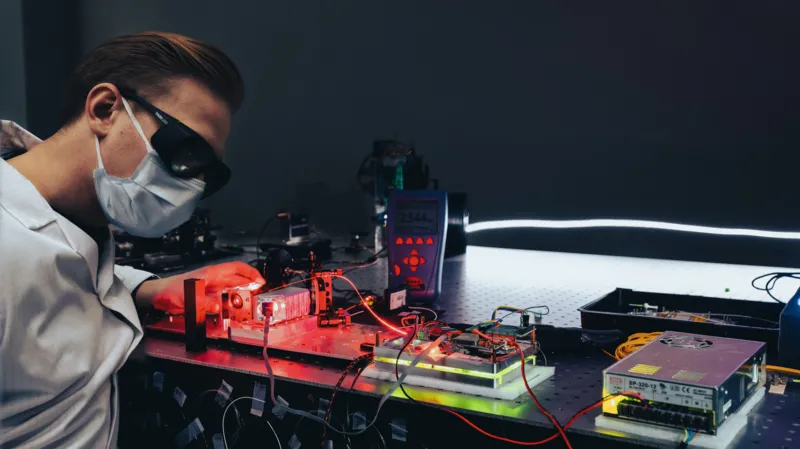
As I walk through the concrete hallways of Vilnius Tech University in Lithuania, the stark murals evoke a Soviet-era feel—hardly the setting you’d expect for a cutting-edge lab working on laser-based communication. Yet here is where Astrolight, a Lithuanian space-tech startup founded six years ago, is headquartered. The company has recently secured €2.8 million (approximately $3.3 million or £2.4 million) in funding to develop what it describes as an “optical data highway.”
Think of it as an invisible internet cable connecting satellites with ground-based systems.
With around 70,000 satellites projected to launch over the next five years, the need for advanced communication technologies is growing rapidly. Astrolight aims to help shift the industry away from traditional radio frequency communication and toward faster, more secure laser-based alternatives.
The company’s laser systems have strong defense applications as well—particularly relevant given current regional tensions, especially Russia’s aggressive stance toward neighboring countries. Astrolight is already involved in NATO’s DIANA (Defence Innovation Accelerator for the North Atlantic) initiative, launched in 2023 to adapt civilian innovations for military use.
One early adopter is the Lithuanian Navy, which reached out to Astrolight three years ago, seeking a laser system that could allow ships to communicate without using detectable radio waves.
“We told them, ‘We’ve developed this for space, so it’s very possible we can adapt it for ground-based needs too,’” says Laurynas Maciulis, Astrolight’s CEO and co-founder, based in Vilnius.
Laser communications are attractive to the military because they are difficult to intercept or jam. They also have the advantage of being hard to detect.
“In Ukraine, if you turn on a radio transmitter, you instantly become a target because it’s easy to trace,” Maciulis explains. “With our technology, data travels through a tight laser beam that’s extremely difficult to locate.”
Despite Lithuania’s relatively modest defense budget—around £2.5 billion compared to the UK’s £54 billion—its defense spending as a share of GDP is significant. It currently allocates about 3% of its GDP to defense, a figure expected to rise to 5.5%, well above the UK’s 2.5%.
Lithuania has built a reputation for excellence in specialized tech, such as Astrolight’s laser systems. Roughly 30% of its space-related projects receive EU funding, nearly double the European average.
According to Šarūnas Genys of Invest Lithuania, space innovation is becoming a key component of the country’s national security strategy. He cites examples such as Delta Biosciences, a Lithuanian life sciences firm preparing to test radiation-resistant compounds aboard the International Space Station. These developments could have future military applications, such as supporting special forces in high-radiation environments.
Another example is Kongsberg NanoAvionics, a satellite manufacturer based in Vilnius that has landed a major contract to build hundreds of satellites. While primarily commercial, this kind of infrastructure can also serve military needs, such as secure communications and real-time surveillance across NATO’s eastern front.
Lithuania’s growing space sector also includes Blackswan Space, a startup that has developed a vision-based satellite navigation system. Unlike traditional setups, it doesn’t require constant ground control input—making it ideal for the upcoming satellite boom. In military scenarios, the same system could be used for satellite-based training or even disabling enemy satellites.
Still, selling these innovations to the Lithuanian military hasn’t been easy, admits Blackswan’s Chief Commercial Officer, Tomas Malinauskas. He’s concerned that the government isn’t investing enough in homegrown solutions.
Instead of purchasing a $300 million drone from abroad, he argues, Lithuania could build its own satellite constellation for secure communication and surveillance.
“It would not only boost our space industry, but also offer sustainable, long-term value to our defense strategy,” Malinauskas says.
Space Hub LT, led by Eglė Elena Šataitė, is a government agency working to support the country’s space startups. She notes that national security considerations are pushing the government to recognize space technology as an essential part of defense capabilities.
Lukas Savickas, Lithuania’s Minister of Economy and Innovation, acknowledges the concerns raised by industry leaders and says the government is reassessing how it supports the space sector.
“Space tech is one of the highest value-added sectors,” Savickas explains. “It connects with biotech, AI, optics, and other advanced fields.”
No matter how government support evolves, Lithuania’s entrepreneurial drive remains strong.
“We constantly need to prove we belong on the global stage,” says Dominykas Milasius, co-founder of Delta Biosciences. “Innovation for us is not just economic—it’s geopolitical. We’re building technologies that make Lithuania worth defending.”
ALSO READ : Zimfest Promises a Show of a Lifetime

For comments, Feedback and Opinions do get in touch with our editor on WhatsApp: +44 7949 297606 or Email: editor@thezimbabwetimes.co.zw.

