
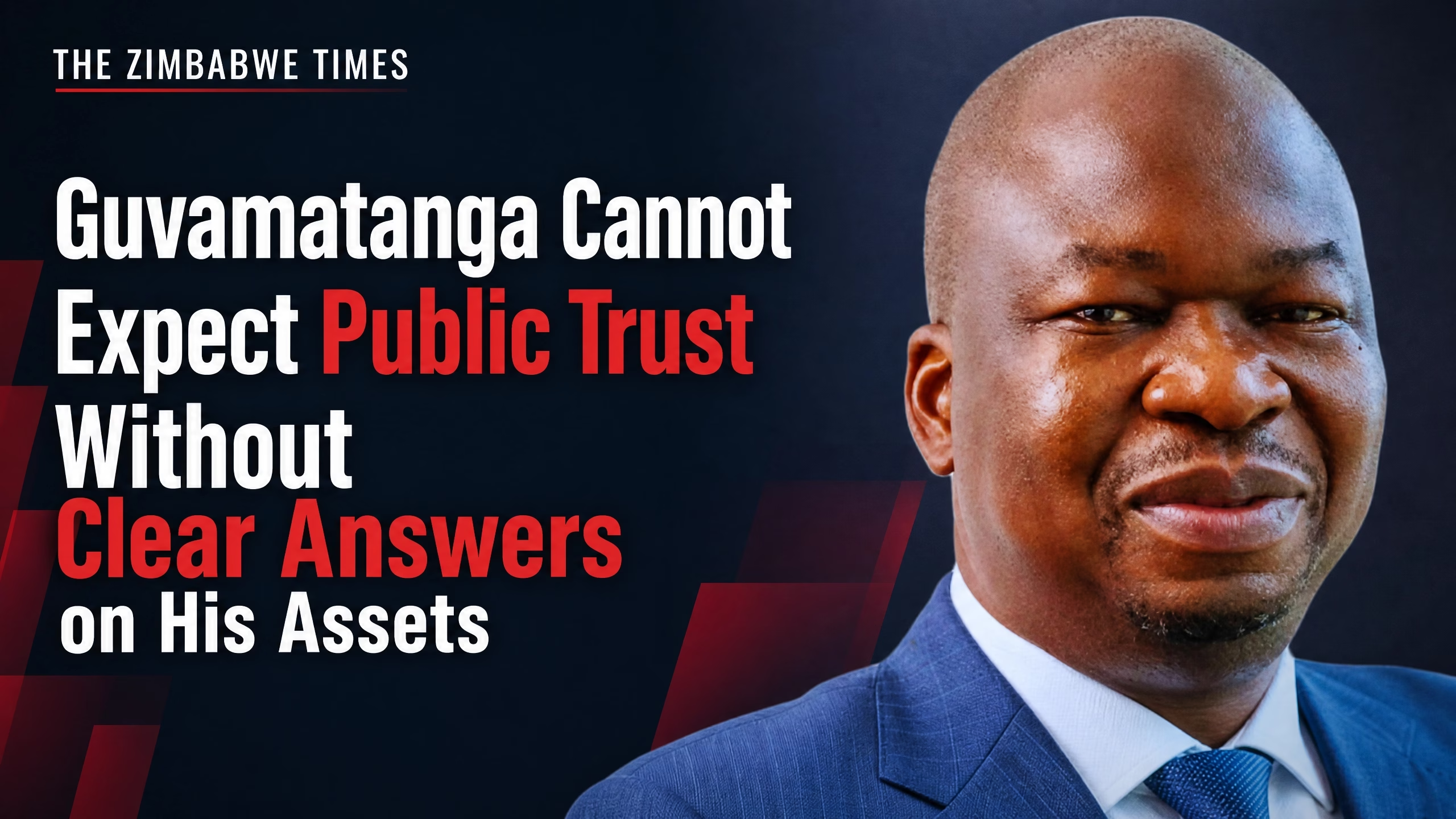
Finance Secretary George Guvamatanga is once again facing intense public scrutiny over his wealth and property interests after a Zimbabwe Revenue Authority (Zimra) information-gathering exercise at Borrowdale Brooke revived claims about his alleged holdings in the affluent Harare suburb.
The latest controversy is serious—not because every allegation circulating online is necessarily true, but because the official at the centre of the storm occupies one of the most powerful economic positions in the country. Guvamatanga helps shape tax policy, public revenue collection and financial decisions that affect millions of Zimbabweans. His personal finances are therefore a legitimate matter of public interest.
A notice attributed to the Borrowdale Brooke homeowners’ association said Zimra had requested information on properties in the gated community. The requested details reportedly included property owners’ names, tenants and lease commencement dates. The association said it was legally obliged to cooperate under Section 39 of the Income Tax Act.
The notice has not, by itself, established that Guvamatanga owns property in the estate. Nor has it confirmed the widely circulated claim that he owns as many as 25 houses there. No documentary evidence proving that claim has been publicly produced.
But the lack of proof does not erase the need for answers. It makes verification even more important.
Guvamatanga has previously acknowledged owning property in Zimbabwe and other jurisdictions. During an earlier controversy, he said his banking career had enabled him to purchase assets in Africa, Europe and elsewhere from 2003. He also said he had built a real-estate business and developed a farming enterprise.
His representatives have maintained that properties associated with him were purchased using funds earned during his years at Barclays. That explanation may be plausible, but public confidence cannot rest on assurances alone. The central questions remain whether the assets were lawfully acquired, properly declared where required and consistent with the applicable rules governing senior public officials.
Also Read: Tungwarara places jobs and local businesses at the centre of investment drive
The public has also heard claims that Guvamatanga declared approximately 40 properties when he entered government in 2018. That assertion, previously attributed to guest writer Forward Madyira, has not been supported in the material available for this report by publicly verifiable records.
If such a declaration exists, it could help establish what Guvamatanga owned before taking public office. If it does not, that too should be made clear. Transparency cannot be selective, and claims made in defence of a public official should face the same evidentiary test as claims made against him.
This is where the controversy becomes uncomfortable for the government. Zimbabwe is demanding more from taxpayers while asking citizens and businesses to accept increasingly intrusive scrutiny from revenue authorities. Guvamatanga said in February that the country’s tax-to-GDP ratio, then about 17 percent, should rise towards 22 percent, with annual revenue eventually exceeding US$10 billion.
Those ambitions may be necessary for the state’s finances, but they also create a higher standard for the officials enforcing them. A Treasury chief urging citizens to meet their tax obligations must be able to answer credible questions about his own financial affairs with clarity, documentation and consistency.
At the same time, there is no evidence in the material reviewed that the Borrowdale Brooke exercise was personally ordered by Guvamatanga or that it was launched as retaliation against his critics. Zimra has described the exercise as part of routine compliance work rather than a campaign against a particular resident or neighbourhood.
That explanation should be tested, not automatically accepted or dismissed. The homeowners’ association’s notice, the scope of Zimra’s request and any eventual findings should be made available in accordance with the law and legitimate privacy protections. Public officials deserve due process, but the public also deserves meaningful transparency when questions concern wealth, taxes and the exercise of state power.
Guvamatanga is not entitled to be presumed guilty because of social-media rumours. Equally, his senior position should not shield him from scrutiny. The claim that he owns 25 homes in Borrowdale Brooke must either be supported by credible evidence or withdrawn from circulation as an unproven allegation.
The same applies to the broader debate over his wealth. Assertions that his assets were fully declared and acquired before government service must be demonstrable. Assertions that he accumulated unexplained wealth must also be demonstrable. Neither side should be allowed to substitute political loyalty, personal attacks or public relations for evidence.
Zimbabwe has endured too many controversies in which allegations become accepted as fact before records are examined, while official denials are treated as sufficient without independent verification. That cycle damages both accountability and reputations.
The answer is straightforward: disclose what can lawfully be disclosed, investigate what requires investigation and publish credible findings. If Guvamatanga’s assets are legitimate, transparent verification should strengthen his position. If irregularities exist, the public deserves to know and the relevant authorities must act.
The Borrowdale Brooke controversy should therefore not be reduced to gossip about an alleged property empire. It is a test of whether Zimbabwe’s public institutions can apply standards of accountability to those who design and enforce the country’s financial rules.
For a Treasury chief whose policies demand greater compliance from the public, silence and ambiguity are not good enough. Zimbabwe needs evidence, answers and equal treatment under the law.

For comments, Feedback and Opinions do get in touch with our editor on WhatsApp: +44 7949 297606 or Email: editor@thezimbabwetimes.co.zw.

