
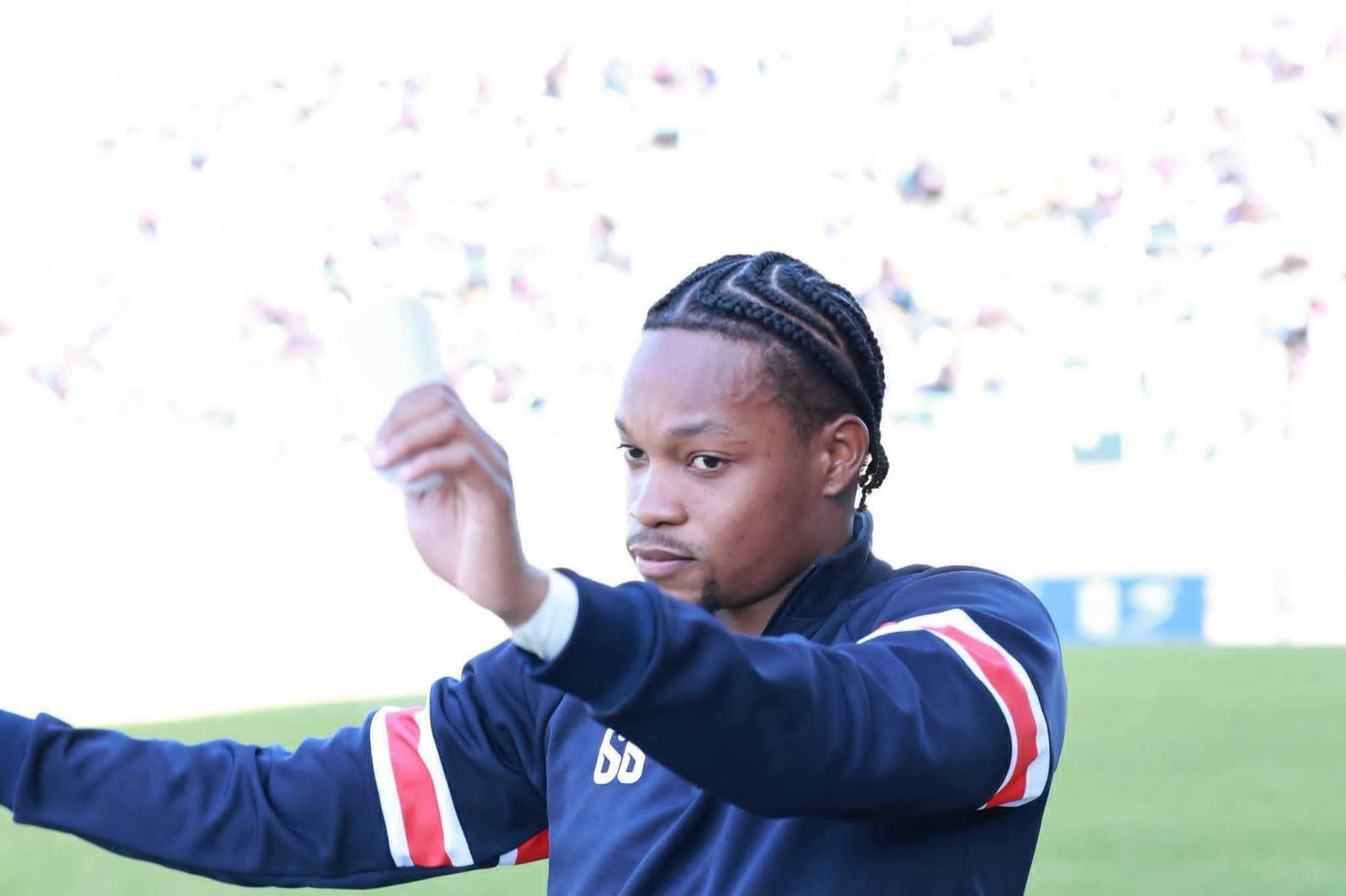
HARARE — Dynamos have reportedly suspended midfielder Nathan Mutasa ahead of Saturday’s Harare derby against CAPS United after an alleged training-ground breach that has raised fresh questions about discipline, standards and the club’s handling of talent.
The incident, reported by Dynamos-focused social-media pages on 2 September, allegedly involved Mutasa bringing his girlfriend to the team’s training venue and spending time with her while the technical staff and players were conducting a session. According to the reports, technical-team member Kosorerai Humayebere ordered the player to leave the premises and instructed him not to return to training until head coach Aristica Cioaba comes back from a coaching course in Tanzania.
The claim has not been accompanied by a public statement from Dynamos, Humayebere or Mutasa, and Hurumende.com has not independently confirmed every detail of the alleged encounter. The suspension should therefore be treated as a reported club action rather than a finding established by an independent disciplinary process.
Even with that qualification, the timing could hardly be worse for Dynamos. The club is preparing for the original Harare derby against CAPS United at Rufaro Stadium on Saturday, 5 September, with kick-off scheduled for 3pm. In a fixture defined by pressure, scrutiny and little tolerance for weakness, losing a player who was brought in to add attacking depth is a needless self-inflicted problem.
What makes the report especially damaging is that it does not arrive in a vacuum. When Mutasa joined Dynamos on loan from Scottland FC in July, Soccer24 reported that Cioaba had already challenged him to change his mentality, work harder in training and accept that reputation alone would not guarantee selection.
Cioaba’s message was unambiguous: Dynamos would not create a special category for one player. The coach said Mutasa was a good-character individual with talent, but stressed that every player had to serve the team and earn minutes through work. Mutasa was subsequently included in the squad for the goalless draw against Simba Bhora but remained an unused substitute.
Zimbabwe Now later reported that Mutasa had regularly made the matchday squad without securing a starting place, again quoting Cioaba’s insistence that “the name doesn’t play” for him and that training performance would determine selection. Those earlier comments were a warning that the player’s challenge at Dynamos was not merely tactical. He had to convince a demanding coach that he could meet the standards expected of a club whose badge carries enormous weight in Zimbabwean football.
If the latest report is accurate, Mutasa has failed that test at the worst possible moment. Bringing a personal guest into a professional training environment during a team session would not be a harmless lapse in etiquette; it would represent a basic failure to understand the purpose of the workplace, the authority of the technical team and the obligations attached to wearing the Dynamos shirt.
Mutasa arrived at Dynamos with a chance to reset his career. His loan move from Scottland offered him an opportunity to win regular football after struggling for opportunities under Norman Mapeza, according to Soccer24. Instead of using the move to build trust, he now finds himself at the centre of a disciplinary controversy before one of the most important matches on the domestic calendar.
That is the frustrating part for Dynamos supporters. The issue is not whether Mutasa possesses ability. The club would not have taken him on loan if his footballing potential were irrelevant. The issue is whether he understands that potential is only an asset when it is matched by reliability, humility and daily discipline.
A player can be gifted and still be unavailable. He can be popular and still be dropped. He can have a history of promising performances and still lose the confidence of a coach. Football clubs are not talent exhibitions; they are collective institutions in which one person’s poor judgment can disrupt preparation for an entire squad.The club also has questions to answer. If Mutasa was suspended, Dynamos must explain the disciplinary basis for the decision, apply its rules consistently and make sure the player is given a fair opportunity to respond. A serious club cannot run its disciplinary system through rumours, social-media posts or selective leaks.
At the same time, accountability cannot mean protecting a player from the consequences of an alleged breach simply because the derby is approaching. If the technical team believes the player compromised training discipline, then the club must be prepared to accept the sporting cost of its decision. A suspension that disappears because a big match is near would tell the rest of the squad that standards are negotiable when the stakes are high.
That would be a disastrous message. Cioaba has already told the public that there are no privileged names at Dynamos. The club now has an opportunity to prove that principle applies beyond press conferences. If Mutasa is cleared, Dynamos should say so. If he is found to have breached team rules, it should impose a proportionate sanction and communicate the position responsibly.
The CAPS United match will provide an immediate measure of the fallout. The Premier Soccer League has confirmed the fixture for Rufaro, where general admission tickets are priced at US$5, grandstand tickets at US$15 and VIP tickets at US$25. The supporters will come expecting intensity, commitment and a team prepared to fight for every ball.
They should not have to wonder whether a player’s avoidable conduct has weakened the squad’s preparation. Nor should teammates who followed the rules be left with the impression that discipline is a public-relations slogan rather than a condition of employment.
For Mutasa, the path back is clear but demanding. It will not be secured by arguments about talent, past reputation or the importance of the derby. It will require an explanation, an acceptance of responsibility if the allegations are substantiated, and consistent conduct when nobody is watching. The fastest way to silence criticism is not a social-media denial or a single flashy appearance. It is a sustained return to training, respect for the technical team and performances that put the team ahead of the individual.
For Dynamos, the obligation is equally clear: stop allowing the aura of the player to become bigger than the rules of the club. The Glamour Boys cannot claim to be rebuilding standards while repeatedly having to manage avoidable distractions around individual players.
The central lesson is blunt. A derby is not lost only on the pitch. It can also be compromised in the training ground, in the dressing room and in the decisions players make when they assume talent will protect them. If the reports surrounding Mutasa are accurate, Dynamos were right to act. But the club must now demonstrate that it can turn a disciplinary episode into a lasting standard rather than another short-lived controversy.

For comments, Feedback and Opinions do get in touch with our editor on WhatsApp: +44 7949 297606 or Email: editor@thezimbabwetimes.co.zw.

