
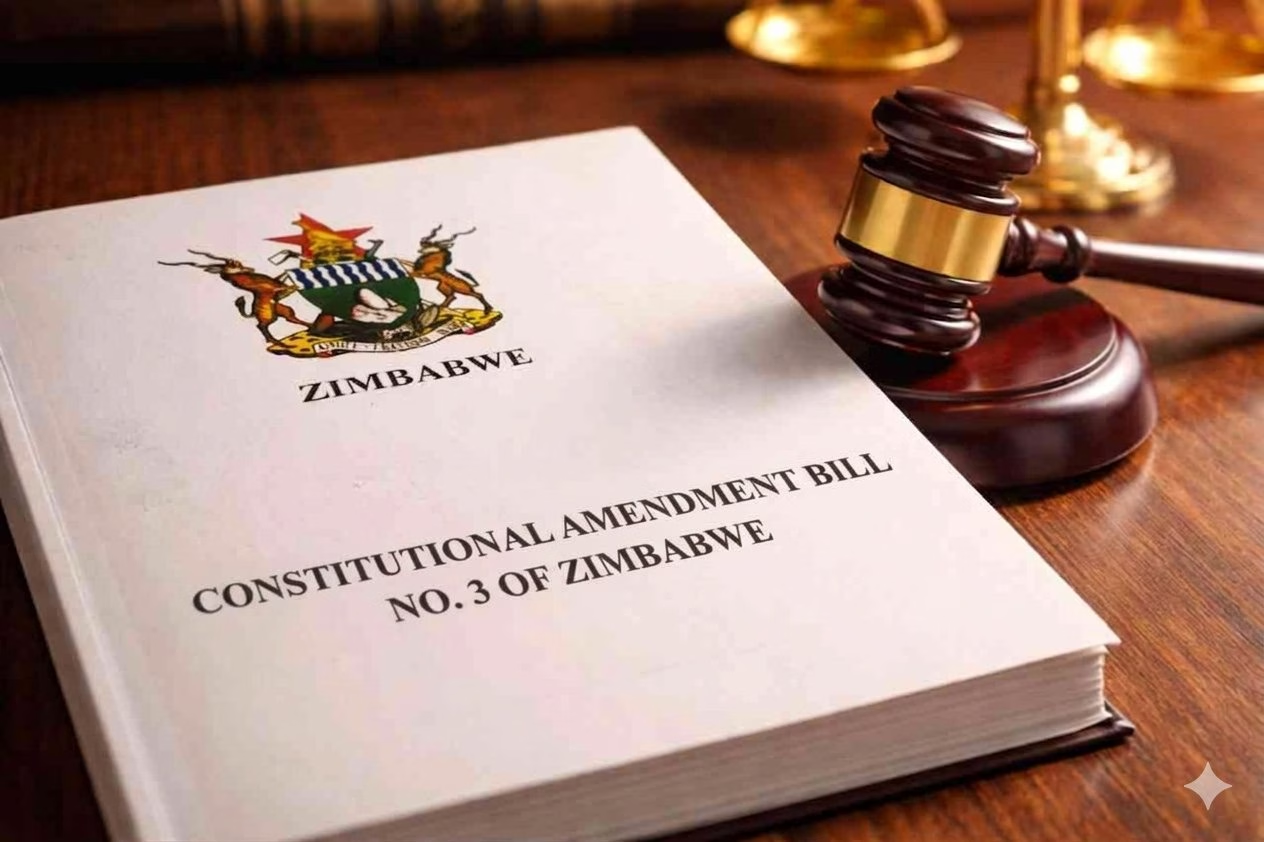
A draft statutory instrument circulating among Zimbabwe’s political opposition lays bare the growing alarm within the country’s political class over Constitutional Amendment Bill No. 3 (CAB3), signaling that resistance to the ruling party’s attempt to entrench presidential power is becoming increasingly organized.
The document, styled as a formal statutory instrument under the Criminal Law Codification and Reform Act, proposes sweeping criminal penalties for public officials who willfully violate explicit provisions of Zimbabwe’s 2013 Constitution. Its authorship remains unknown, but its drafting, which is technically precise, drawing directly on the language of Zimbabwe’s constitutional framework, suggests legal minds of considerable standing are involved.
Titled the “CAB3 Democratic Backsliding and Wilful Violation of the Constitution Criminal Regulations (Criminal Law Codification and Reform Act),” the draft instrument would make it a criminal offense for any public officer – including the President, cabinet ministers, members of parliament, judges, and security service personnel – to engage in conduct that contravenes, negates, defeats, or fails to give effect to an explicit constitutional provision.
Critically, the draft removes the standard defense of acting on superior orders, party resolutions, or political expediency. There would be no hiding behind Cabinet, ZANU-PF’s conference resolutions, or claims that a violation was in the national interest.
The penalties proposed are severe. Conviction would carry a mandatory prison term of between ten and twenty years, with no option for a fine to be substituted. Courts would be expressly prohibited from suspending the minimum ten-year term. Conviction would also trigger the consequences for holding public office provided for elsewhere in the Constitution – in effect, a political death sentence for any official found guilty.
Perhaps most striking is the instrument’s retrospective reach. The draft provides that its commencement date would be on or after 16 February 2026 – the date widely associated with the formal introduction of CAB3 – meaning that conduct linked to the Bill’s passage through parliament could, in principle, fall within scope. Conduct predating that date could still be admitted as evidence to prove knowledge or a pattern of behavior.
The draft also introduces “ancillary liability,” extending criminal exposure to any person who knowingly aids, abets, counsels, or conspires with a public officer to violate the Constitution – potentially sweeping in a wide circle of advisers, legal drafters, and political operatives involved in advancing CAB3.
The emergence of this document coincides with a rapidly deepening political crisis around the Bill’s parliamentary passage. As reported by NewsDay, negotiations between a caucus led by self-styled Citizens Coalition for Change (CCC) secretary-general Sengezo Tshabangu and ZANU-PF over CAB3 were deadlocked as of Tuesday evening, with Tshabangu having issued an ultimatum to the ruling party to secure a political agreement by midnight or face the Bill’s failure in parliament. That deadline has now passed without a publicly announced resolution.
The standoff is a significant complication for President Mnangagwa’s government. While ZANU-PF commands a comfortable majority in the National Assembly, the ruling party requires support from Tshabangu-aligned legislators to secure the critical two-thirds majority needed in the Senate to pass the constitutional amendment.
Tshabangu has made clear his bloc will not be a rubber stamp. “We are not simply going to be an implementation arm of a ZANU-PF conference resolution. We are not voting cows,” his spokesperson Nqobizitha Mlilo warned. Tshabangu is demanding what he describes as a “sincere, broad-based political settlement” serving the national interest – language consistent with his longstanding calls for a Government of National Unity.
Tshabangu’s legislators are meeting in caucus on Wednesday 10 June to determine their final vote on the Bill’s Senate passage – a vote that could either deliver CAB3 into law or bring it to an abrupt halt. At the time of writing, that pivotal moment has yet to occur.
The parliamentary drama is not the only front on which CAB3 faces resistance. A communication purportedly originating from J M Tongogara Barracks and dated 9 June 2026, circulating under the heading “Operation Code Named: People’s Army,” claims to speak on behalf of serving senior officers and NCOs of the Zimbabwe Defence Forces.
The document accuses the military’s top brass of having been financially induced to support the Bill, alleging that major generals were each paid USD 250,000 when summoned to State House, and that service chiefs subsequently received undisclosed sums along with ten cattle apiece at Precabe Farm on 7 June 2026 in exchange for their backing of CAB3.
The document describes these alleged payments as a betrayal of the rank and file. Its authors are unverified, and neither the ZDF nor the government has commented on its contents. Nevertheless, its emergence – whether genuine or fabricated – points to deepening anxiety within Zimbabwe’s security establishment about a constitutional amendment its critics believe is designed to extend presidential tenure and ultimately cancel elections altogether. As the document puts it: “ZDF personnel, CAB3 is not good for us – once you extend their terms for 2 years, they will come back for CAB4 to 20 years, adding more years, and canceling elections and declaring Zimbabwe a Munhumutapa Kingdom.”
Against this backdrop, the criminal regulations draft, whatever its origin, reads less as an abstract legal exercise and more as a statement of intent. It reflects a conviction, held with apparent seriousness by elements of Zimbabwe’s legal and political opposition, that CAB3 represents not merely bad policy but a willful assault on a constitution that hundreds of thousands of Zimbabweans voted for in 2013.
Whether it ever becomes law or not, the document signals that those seeking to hold the line on Zimbabwe’s constitutional order are thinking in terms not of protest, but of prosecution.

For comments, Feedback and Opinions do get in touch with our editor on WhatsApp: +44 7949 297606 or Email: editor@thezimbabwetimes.co.zw.

