
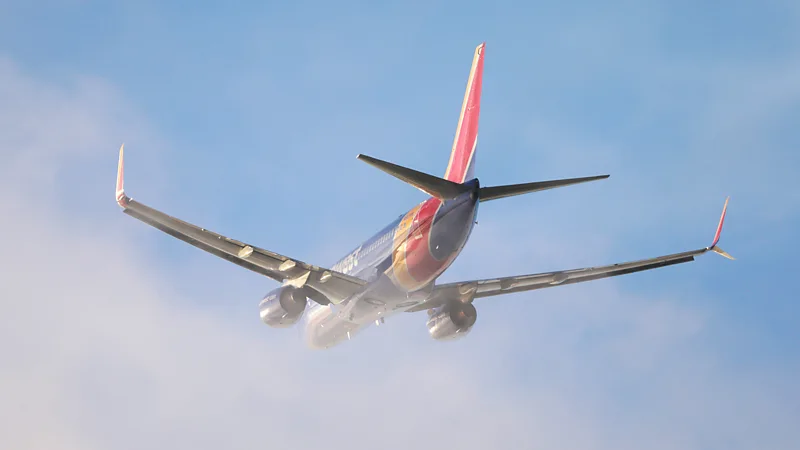
Severe turbulence is becoming more frequent and intense — a trend scientists attribute to human-driven climate change — and aviation experts are racing to reduce its impact.
One shocking example came in 2024 when a Singapore Airlines flight encountered intense turbulence over southern Myanmar. “We saw blood on the ceiling… it was total chaos,” one passenger recalled. Similarly, a United Airlines Boeing 787 flying over the Philippines experienced powerful turbulence that threw a flight attendant against the ceiling, causing serious injuries.
These incidents are becoming more common. According to atmospheric scientist Paul Williams of the University of Reading, extreme clear-air turbulence — the kind that’s invisible to satellites, radar, and the naked eye — has increased by 55% since reliable records began in 1979. Projections suggest turbulence could triple globally by the 2050s, especially affecting routes over East Asia and the North Atlantic.
Besides endangering passengers, turbulence adds significant costs to the aviation industry through equipment wear, extended flight times, and higher fuel consumption. The issue is serious enough that engineers, scientists, and tech companies are working on ways to minimize its effects.
Engineering Countermeasures and Innovations
In Austria, a company called Turbulence Solutions is experimenting with small “flaplets” attached to aircraft wings. These tiny, dynamic devices adjust to shifts in airflow to help stabilize the plane — mimicking how birds subtly alter their feathers during flight. Tests on smaller aircraft show the system can reduce turbulence impacts on passengers by more than 80%, and CEO Andras Galffy believes the technology can scale up for use on commercial jets.
“The standard approach is to either avoid turbulence or endure it by strengthening the plane and buckling up,” Galffy explains. “But we argue that with the right counter-signals, you don’t have to just accept it.”
Artificial Intelligence Tackles the Chaos
Since turbulence is inherently unpredictable — shaped by countless factors from wind currents to nearby aircraft — researchers believe AI could be key to understanding and reacting to it in real time. Ricardo Vinuesa, a specialist in fluid dynamics and AI at the KTH Royal Institute of Technology in Stockholm, sees potential in AI’s ability to detect patterns in complex datasets.
In recent trials, Vinuesa and his team used deep reinforcement learning — similar to how children learn through trial and error — to train an AI model that controlled jets of air on a virtual aircraft wing. Rather than relying solely on upstream measurements, this system analyzes airflow conditions directly at the wing to make near-instant adjustments. Importantly, their approach uses explainable AI, meaning it can identify which data points are driving its decisions.
Other teams are exploring turbulence forecasting and sensing using various technologies. Caltech and Nvidia, for instance, have tested an AI-driven turbulence prediction system in wind tunnels. NASA’s Langley Research Center has worked on detecting distant turbulence by capturing low-frequency infrasound signals.
Lidar — the same laser-scanning tech used by autonomous vehicles — is also being explored to map air movements ahead of an aircraft in 3D. A 2023 study from China proposed a dual-wavelength lidar system capable of detecting turbulence several kilometers ahead. However, current lidar setups are too bulky and power-intensive for widespread use on commercial flights.
Forecasting Is Improving — But Not Perfect
Modern pilots rely on a range of tools before takeoff, from jet stream maps to software like the Graphical Turbulence Guidance (GTG) system developed in part by Paul Williams. “About 20 years ago, we could predict about 60% of turbulence,” Williams says. “Now we’re closer to 75%, but I want to keep pushing that number higher.”
One major challenge is access to accurate, high-altitude wind data. Much of what we know comes from roughly 1,300 weather balloon stations worldwide and data from the 100,000 commercial flights in the air each day.
To close the data gap, the Turbulence Aware initiative by the International Air Transport Association (IATA) now collects anonymized real-time data from participating airlines such as Air France, EasyJet, and Aer Lingus. Meanwhile, apps like Turbli provide turbulence forecasts to travelers — a glimpse into the data that pilots have long had access to.
“I use Turbli,” Williams says. “It’s fairly reliable, though it can’t predict turbulence on your exact route. Sometimes it helps, but it can also be like a hypochondriac checking WebMD — not always reassuring.”
Looking Ahead
With climate change intensifying turbulence and more passengers affected each year, the race is on to build safer, smarter aircraft. Innovations in sensors, AI, and aircraft design could make flying more stable in the decades to come — but until then, turbulence remains a growing challenge for the aviation industry and passengers alike.
ALSO READ : US-China Trade Talks Resume Amid Hopes for Extended Truce

For comments, Feedback and Opinions do get in touch with our editor on WhatsApp: +44 7949 297606 or Email: editor@thezimbabwetimes.co.zw.

