
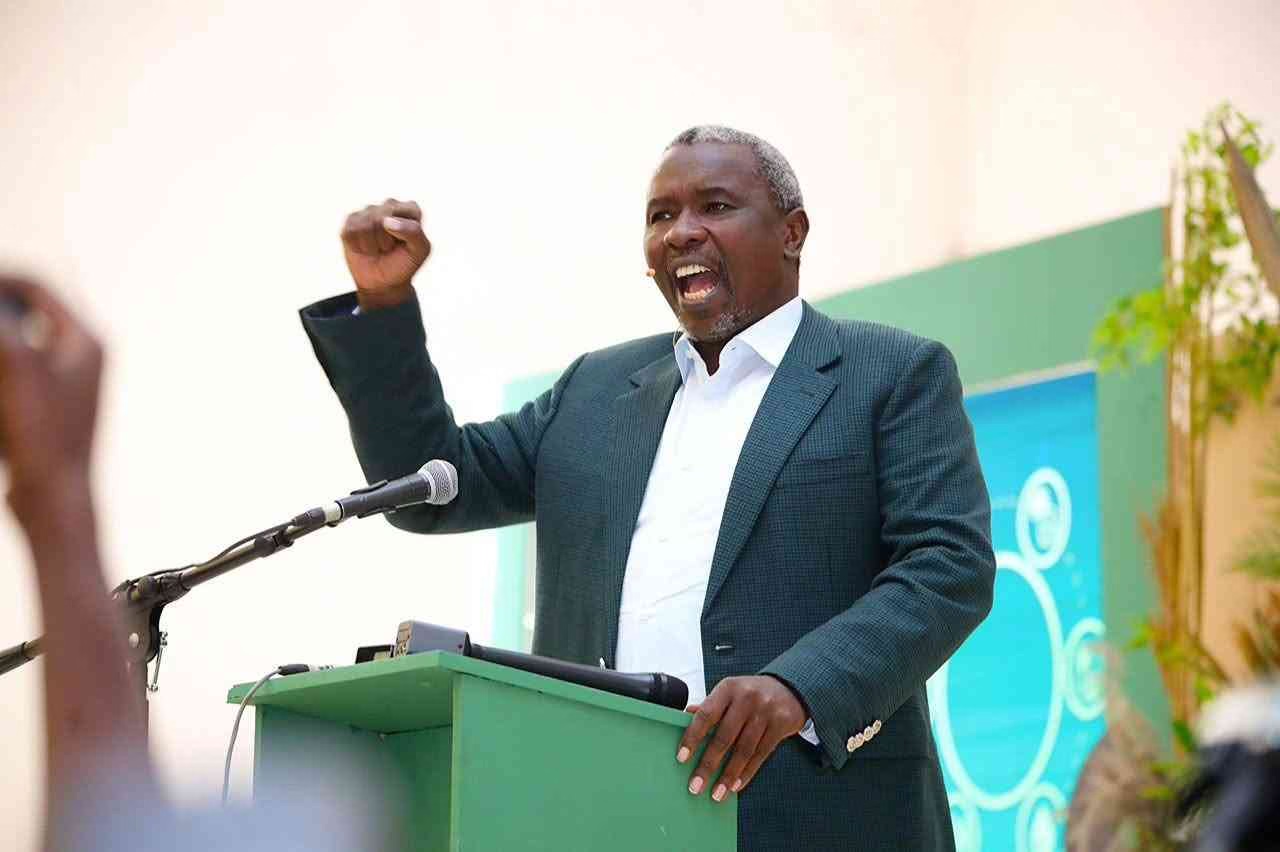
The appointment of businessman Kudakwashe Regimond Tagwirei to Zimbabwe’s Senate places one of the country’s most influential and controversial business figures inside a chamber whose work reaches far beyond ceremonial politics. NewsDay reported on 18 August that Tagwirei was among 10 senators appointed under Constitutional Amendment No. 3, after Parliament was formally notified of the appointments.
The announcement is significant for two reasons. It brings a prominent private-sector figure into the legislature, and it tests the meaning of Zimbabwe’s newly expanded presidential appointment power. Tagwirei will now have a formal role in making laws, scrutinising government and representing national interests—responsibilities that carry constitutional obligations regardless of a senator’s business experience or political connections.
Tagwirei is best known as the founder and chief executive of Sakunda Holdings, a Zimbabwean company with interests associated with fuel, agriculture and other strategic sectors. The U.S. Department of the Treasury identified him in 2020 as Sakunda’s founding director and chief executive, describing him as a businessman with longstanding associations with senior Zimbabwean officials.
That background has made Tagwirei an important figure in Zimbabwe’s political economy. It has also made him the subject of intense public debate. In its 2020 designation, the U.S. Treasury alleged that he used relationships with senior officials to obtain state contracts and preferential access to foreign currency. It also linked Sakunda to the financing of the Command Agriculture programme and referred to a parliamentary inquiry into questions surrounding public funds. Those are allegations and findings attributed to the U.S. government and parliamentary processes; they should not be presented as a court judgment against Tagwirei.
His Senate appointment therefore carries an immediate question of public confidence: can a businessman whose companies have operated in sectors closely connected to the state now help scrutinise the same state’s policies and spending? The answer will depend not only on his speeches, but on his conduct—particularly his transparency, management of potential conflicts of interest and willingness to submit to parliamentary oversight.
A senator is a member of the upper house of Parliament. Zimbabwe’s Parliament consists of the Senate and the National Assembly. According to the official parliamentary description, the Senate has 80 members, while the National Assembly has 270. The two chambers form part of the country’s legislative system and operate within the constitutional principle that Parliament must promote democratic governance and ensure that public institutions act constitutionally and in the national interest.
The title “senator” does not make Tagwirei a minister, permanent secretary or executive official. He does not receive authority to run a ministry simply because he has entered the Senate. His authority is legislative and oversight-based: he may participate in parliamentary debates and committees, contribute to the passage or amendment of laws, question government policy through parliamentary procedures and help hold public institutions accountable.
The constitutional purpose of Parliament is broad. The Parliament of Zimbabwe states that the legislature has power to make laws for the “peace, order and good governance” of the country and has legislative, oversight and representative functions. For Tagwirei, this means that his new role should be measured against the quality of his parliamentary work: the questions he asks, the evidence he demands, the laws he supports and the interests he represents.
The first significance is the arrival of economic expertise—and the debate that comes with it. A senator with experience in energy, agriculture and business may bring practical knowledge of investment, supply chains, fuel security, employment and industrial policy. Zimbabwe’s legislature often debates precisely these issues. Tagwirei’s experience could be useful if it is converted into evidence-based law-making rather than private influence.
The second significance is the expansion of presidential influence over the Senate. The 2026 amendment created the legal basis for 10 additional presidential appointments, according to constitutional analysis by ConstitutionNet, which says the change would raise the Senate from 80 to 90 members. Parliament separately lists the Constitutional Amendment No. 3 Bill as a 2026 parliamentary document. The appointment of Tagwirei under that new arrangement means the debate is no longer abstract. It concerns how an enlarged appointed bloc may affect the balance, independence and public legitimacy of the upper house.
The third issue is accountability. Senators are not outside the reach of scrutiny because they were appointed rather than elected. On the contrary, appointment can heighten the public demand for disclosure: why was a particular person selected, what expertise does he bring, and how will he separate public duties from private interests? A senator connected to companies that depend on government policy will face especially close questions whenever the Senate considers energy, agriculture, procurement, public finance or sanctions-related matters.
Finally, the appointment raises the question of representation. The Senate is designed to give space to interests and perspectives that may not be fully reflected in constituency-based politics. Tagwirei may present himself as a voice for business, investment and economic growth. But the constitutional standard is wider than sectoral advocacy. His obligation is to act in the national interest, including the interests of citizens affected by inflation, unemployment, shortages, public debt and the quality of public services.
Tagwirei’s appointment gives him a platform, not a blank cheque. His business record may give him unusual insight into Zimbabwe’s economy, while the controversies surrounding his public profile make credibility and transparency central to his tenure. The Senate will provide the setting in which those competing perceptions are tested.
The most consequential measure of his appointment will be whether he strengthens Parliament’s ability to examine executive decisions openly and rigorously. If he uses his experience to improve policy while declaring and managing conflicts, he could become a valuable contributor to national debate. If the office appears to turn commercial access into legislative influence, the appointment will deepen concerns about the concentration of political and economic power.
For now, Tagwirei’s entry into the Senate marks a new chapter in the relationship between Zimbabwe’s boardrooms and its institutions of government. What it ultimately means will be determined less by the ceremony of appointment than by the standards he applies to himself—and by the scrutiny Parliament and the public apply to him.

For comments, Feedback and Opinions do get in touch with our editor on WhatsApp: +44 7949 297606 or Email: editor@thezimbabwetimes.co.zw.

